There’s a stubborn myth that a “real garden” needs a big backyard. Like, a big backyard.
The kind where you mow for two hours, question every life choice, and wonder if you accidentally bought a small farm instead of a house.
Rows of corn, cattle panel fences, raised beds lined up like soldiers, irrigation systems, potting sheds, wheelbarrows, compost tumblers, and probably a rooster named Kevin judging the entire operation.

Can One Pot Garden Feed A Family? Yep. Here’s How.
And listen, that’s awesome if you’ve got it. But most people don’t. Some have a patio, a porch, a stoop, a deck, a sunny window, or, at best, a modest backyard that isn’t auditioning for a gardening reality show.
So the real question isn’t Do you need a big yard to grow food? The real question is Can a container garden actually help feed a family and cut grocery costs without taking over your life?
And the answer is: yes. Absolutely. One pot won’t replace acres of wheat or field corn, but it can give you fresh produce and herbs that supplement meals week after week, stretch the grocery budget, and make cooking taste 10x better without needing a national park worth of space.
So let’s get into it. One pot. Nine plants. Zero nonsense.
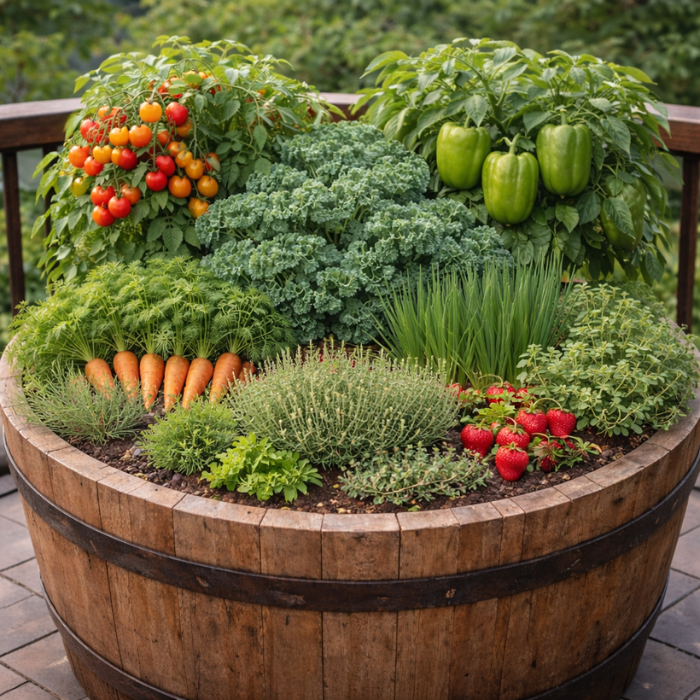
The Right Pot Is The Hero Of This Story
If you want to grow multiple crops together, the container needs to be big enough to hold everyone comfortably without turning into a root wrestling match.
Here are pot sizes that can actually work for this:
- Standard round pot: Minimum 18″ wide and 12″ deep. Best 24-30″ wide and 14-18″ deep.
- Large planter box: Minimum 24″ x 12″ x 12″. Best 36-48″ long and 14-18″ deep.
- Half whiskey barrel planter: 26-30″ wide and 16-18″ deep. This one is really ideal for mixed gardens because it drains well, holds moisture longer, and gives roots room to grow without cooking in the summer heat.
The pot in the above photo is a round wooden barrel planter, so that’s what we’re working with today. It’s wide, deep, drains well, and can hold a lot of growth. Perfect.
The 9 Plants That Can Coexist Without Drama
Here’s what’s going into this container, and yes, all from seed or clove depending on the plant:
- Dwarf/Cherry Tomato
- Bell Pepper
- Curly Kale
- Green Onions
- Carrots
- Mini Strawberries
- Thyme
- Oregano
- Rosemary
What we’re not planting in this pot:
- Squash, cucumbers, corn, pumpkins, watermelon, mint, or anything that wants to vine like it’s starring in the upside down in Stranger Things. They need their own space and will take over and push out the other plants.
Seedlings Or Seeds? Both Work, But Not The Same Way.
If you’re planting for the best success, seedlings give tomatoes and peppers a head start, but today let’s lean into a full seed-start scenario, so you can sow everything the same day.
But just to be clear:
- Planting day can be the same
- Sprouting day will be staggered
- Harvest timing will be staggered too
Because plants don’t care about your calendar. They sprout when they’re ready. It’s annoying, but also kind of beautiful when you stop expecting them to do what you want them to and just embrace it.
How To Plant All Seeds In One Pot On The Same Day
Here’s the spacing and placement guide you can use:

- Tomato: 2 seeds, 2″ apart
- Sweet Pepper: 2 seeds, 2″ apart
- Curly Kale: 4 seeds, 8″ apart
- Green Onions: 10 seeds, 1″ apart
- Carrots: 10-12 seeds, 2″ apart
- Mini Strawberries: 2 starters, 6-8″ apart
- Rosemary: 2 seeds, 2″ apart
- Thyme: 6-8 seeds, 4″ apart
- Oregano: 6-8 seeds, 4″ apart

Germination Timeline Reality (Because People Will Ask)
Here’s what they can expect after planting all seeds on the same day:
- 5–12 days: Curly Kale
- 7–14 days: Green Onions, Oregano
- 10–21 days: Dwarf/Cherry Tomato, Bell Pepper, Carrots, Thyme
- 14–30 days: Rosemary
You’ll get waves of seedlings, not synchronized sprouting. And that’s okay. The pot is designed for continuous harvest, not a one-day harvest finale.
Light Needs: The Pot Wants Sun
Most plants in containers need strong light, especially tomato and peppers.
Aim for:
- 6–8 hours of direct sunlight
- Outdoors: natural pollinators will handle most of the work
- Indoors: supplement with a grow light if needed, but the taller plants still go toward the back
Without strong light:
- Tomato gets leggy
- Pepper sulks
- Herbs stretch like they’re trying to escape the pot
And we don’t want escape-artist herbs. We want dinner herbs.
Watering Plan: Deep, Consistent, Not Soggy
Container gardens dry out faster than in-ground gardens, but big pots like this one hold moisture longer.
Watering routine that works:
- Check soil daily
- Water deeply, slowly
- Let it drain every time
- Water again only when the top inch feels dry
Overwatering leads to root rot. Underwatering leads to sadness. Both are avoidable with consistency.

Feeding Plan: Dirt Isn’t Nutrients, Add Compost Or Fertilizer
Start with a high-quality potting mix and add compost or a balanced fertilizer every 2 weeks once plants are 3-4″ tall.
Tomatoes and peppers are heavy feeders. Herbs are moderate feeders. Greens need nitrogen. Compost covers most of this beautifully.
Drainage: The Secret MVP
The wooden barrel planter we’re working with already has the right drainage vibe. That’s why it works.
If the pot doesn’t drain, nothing else matters. Roots rot, fungus shows up, plants get sad, and gardeners blame themselves instead of the drainage. We’re not doing that.
Pruning + Support: Tomato Needs A Trellis, Herbs Need Snipping
The photo above includes tomato and peppers on a small bamboo trellis. That support is key for keeping them upright, off the soil, and productive without smothering the others.
Prune herbs as needed. Snip chives and cilantro before they bolt. Harvest radishes early so roots don’t compete.
Pollination: Outdoors Usually Handles It
Bees usually handle tomatoes and peppers outdoors. But if your pot is sheltered on a porch or deck, gently shake tomato and pepper flowers a few times a week when they bloom.
Yes, it looks weird. Yes, it works.

Harvest Timing: The Pot Is A Food Machine, Not A One-And-Done
Here’s the thing to know up front:
This pot isn’t going to hand you everything at the same time like a perfectly timed dinner bell.
Some stuff shows up early.
Some stuff takes its sweet time.
And some stuff just keeps paying rent all season if you don’t butcher it.
What you’ll harvest first (or pretty early):
Green onions are usually the first thing you can start using. Snip what you need, leave the base, and they keep coming back.
Carrots can be pulled once they size up, but they’re not “instant.” They’re more like “wait… wait… okay NOW.” You can also pull a few early as baby carrots and leave the rest to keep growing.
Mini strawberries can produce pretty early if they’re already established plants. If they’re started from seed, they’re slower. Either way, once they start, it’s more of a steady trickle than one big harvest.
The steady producers (cut and keep going):
Curly kale is a workhorse. Pick outer leaves, let the center keep growing, and it’ll keep producing for a long stretch.
Thyme, oregano, and rosemary are snip-and-keep-going plants. You’re not “harvesting” them once. You’re grabbing what you need over and over.
What comes later (but is worth the wait):
Dwarf/cherry tomatoes and bell peppers are the late bloomers. They take longer to get rolling, but once they do, it turns into ongoing picking instead of one-and-done.
So yeah – this pot is a continuous food machine, not a synchronized harvest parade.
You’ll be snipping, picking, and pulling at different times depending on what’s ready… and that’s exactly what makes it useful.
Final Takeaway
Do you need a backyard to feed a family from a garden?
Nope.
Do you need tons of space?
Nope.
Can you grow real food in one pot that supplements your family’s meals and cuts grocery costs?
Yep. You can.
One pot.
Ten plants.
Just steady harvesting and smart planting.
🛒 Need the pot and supplies? Grab the full setup here: One-Pot Garden Starter Kit

🛒 Shop My Favorite Gardening Finds
Looking for the products and tools mentioned in my blog posts and YouTube Gardening videos?
Visit my Amazon shop to see everything in one place.
Shopping there is free and the site gets a percentage of sales. Thanks!


Leave a Reply